
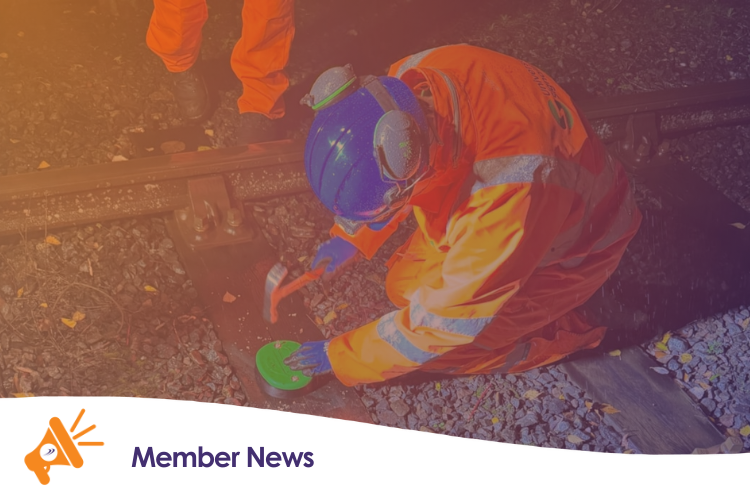
Network Rail’s trial of Universal Signalling’s ‘U-Cross’ system marks a significant step forward in delivering next-generation, safer signalling to rural railway lines across Britain.
Developed by Universal Signalling and first demonstrated at the Global Centre of Rail Excellence in Onllwyn, South Wales, in 2024, the technology has already been recognised as a potential game-changer for the rail industry.
The system provides signallers with real-time information on the precise location of trains, enabling quicker, safer decision-making at user-worked level crossings – used daily by farmers, landowners and rural communities.
The challenge
User-worked crossings are common on rural lines and require users to contact the signaller by telephone before crossing. While current processes are safe, signallers often rely on train-location information drawn from several different sources, which can result in delays for people waiting to cross.
‘U-Cross’ addresses this challenge by delivering real-time, enhanced situational awareness directly to the signaller – including exactly how many minutes are available to cross safely before the next train arrives – enabling faster, safer decision-making.
Solutions of this kind traditionally take years to develop and can be costly, but the combined efforts of Universal Signalling, Network Rail Wales & Borders and Transport for Wales – co-funded by the Innovation Acceleration Forum – enabled this trial to be delivered quickly and effectively.
How the UK-first mainline trial worked
The two-week trial (3 – 14 November) took place on an 11-mile section of the Heart of Wales line between Llandeilo and Llandovery, covering 20 user-worked crossings.
As part of the trial:
- The track was fitted with U-Beacon Universal Locator Beacons, visible as green discs attached to the sleepers through Llandovery Station.
- In-service Transport for Wales trains were fitted with readers and communications equipment.
- Trains automatically transmitted their position to the signaller when approaching or clearing a crossing.
- The systems in-built health and performance monitoring capability collected more than 400,000 data points for the team to analyse.
Thanks to the system’s rapid installation capability, the entire 11-mile stretch was fitted in just two and a half overnight line blocks, with no advance line side design work required – demonstrating the substantial efficiency and cost benefits for future signalling renewals and upgrades, as well as the advanced safety protection for level crossing users.
The next phase will look to extend the technology across the full 96-mile Heart of Wales line, which has 126 crossings, before exploring opportunities on other rural rail routes across the UK.
Anthony Aldred, Operations Manager, Network Rail Wales and Borders said, “Managing access to the railway at user-worked crossings is a key part of keeping our network safe for the people and communities who rely on it. In rural areas, where signallers rely on information from multiple sources, U-Cross gives them a clear, instant view of train locations and visual confirmation of whether a crossing is safe to use, while defaulting to established procedures if a fault is detected.
“This product has real potential to further strengthen safety and reduce delays for users and it has been incredibly valuable to support this project.
“We’re proud to be part of this UK-first trial as we work with Universal Signalling and our industry partners to explore how it could benefit more locations across the network.”
Stephen Head, Chief Executive Officer at Universal Signalling said, “U-Cross is the first stepping stone towards our vision for next-generation digital signalling that’s affordable for rural lines. What truly sets this apart is the speed of deployment, which drives down cost to the railway.
“We’ve automated and productionised as much of the process as possible, stripping out much of the cost base. Fitting 11 miles of track in just two and a half overnight possessions, with no prior design work, shows what’s possible with our system.
“It’s been a delight working with the Wales & Borders teams, and the support from Transport for Wales has been fantastic. Feedback from this trial and analysis of the data collected will inform refinements ahead of the next phase.”
Network Rail is proactively adopting innovative technologies to enhance the passenger experience, strengthen safety and deliver smarter, more cost-effective ways of running the railway.